How to Access and Play GN-Math HTML Games Unblocked at School
GN-Math HTML is a curated repository of over 150 browser-based games disguised under an educational name to bypass school web filters. As of mid-2026, the primary official domain has migrated to gn-math.dev. To play privately, users typically utilize the site's built-in "Launch" feature, which injects the game code into an about:blank window, effectively hiding the activity from local browser history logs.
Navigating school or corporate web filters can be a frustrating experience for students and employees looking for a brief mental break. Over the years, network administrators have become highly capable at blocking popular gaming portals like CoolMathGames or Poki. In response, a sophisticated ecosystem of "stealth" gaming repositories has emerged.
Among these, the GN-Math HTML project ranks among the top choices for users seeking reliable, unblocked entertainment. By leveraging high-speed Content Delivery Networks (CDNs), GitHub Pages, and clever browser injection techniques, this platform provides seamless access to dozens of popular HTML5 titles without requiring any downloads or installations.
This article explores the mechanics behind GN-Math, how to find working mirrors, and the technical steps required to host your own unblockable version using the open-source repository.

Image source: GitHub
What Is GN-Math and Why Is It Called Math?
At first glance, the name "GN-Math" suggests an educational platform dedicated to algebra, geometry, or calculus. Some of the project's public-facing descriptions even market it as a collection of "interactive browser games combining sharp mathematics." However, this is a strategic misdirection.
The reality is that GN-Math is a comprehensive gaming repository. The "math" branding is a deliberate stealth tactic designed to evade automated web filters and casual observation by teachers or IT administrators. Network filters often whitelist URLs containing keywords like "math," "education," or "study." By adopting this naming convention, the site stays under the radar significantly longer than portals with "games" or "arcade" in their domain names.
The developers behind the project are remarkably transparent about this identity gap within their own code repositories. In the official GitHub topic hubs, the creators explicitly state that the repository is a "compilation of gnmaths best games" and humorously refer to it as "your worst school games site."
"These are not my games. This is a compilation... your worst school games site." — GN-Math Repository Documentation
The scale of the project is substantial. According to recent repository data, the collection has grown to host over 150+ free HTML5 games. Because these games are built entirely with web technologies (HTML, CSS, and JavaScript), they require no external plugins like the defunct Adobe Flash Player, making them highly compatible with the low-spec Chromebooks commonly issued by school districts.
Most Popular Games in the GN-Math HTML Collection
The GN-Math library spans multiple genres, including action, puzzle, racing, and retro arcade titles. Because the platform acts as an aggregator rather than an original developer, it pulls in highly celebrated web games from various sources across the internet.
One of the flagship titles frequently associated with the platform is DriveMad, a physics-based racing and puzzle game where players must navigate a blocky vehicle through increasingly complex obstacle courses. Another popular inclusion is Crazy Cattle 3D, an endless runner-style game. These titles are favored because their HTML5 architecture allows them to load quickly and run smoothly, even on devices with limited processing power.
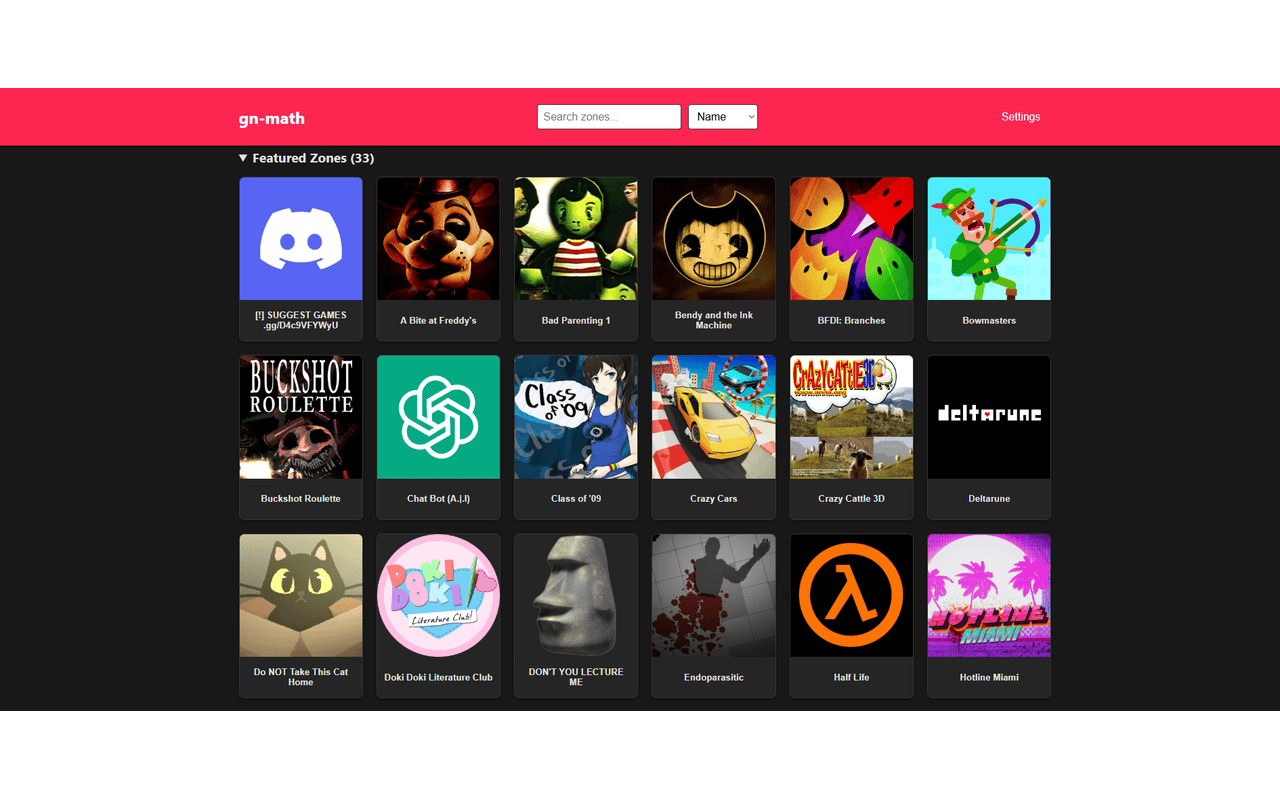
Image source: Chrome Web Store - Google
To help users navigate the extensive library, here is a breakdown of some of the most frequently played games on the platform, categorized by genre and their general "stealth rating" (how easy they are to quickly hide or pause if a teacher walks by).
| Game Title | Genre | Difficulty | Stealth Rating |
|---|---|---|---|
| DriveMad | Physics / Racing | Medium | High (Easy to pause) |
| Crazy Cattle 3D | Action / Runner | Hard | Low (Requires constant input) |
| Retro Bowl | Sports / Strategy | Medium | High (Turn-based elements) |
| 2048 | Puzzle / Math | Easy to Learn | Very High (Looks educational) |
| Slope | Arcade / Reflex | Hard | Low (Fast-paced motion) |
The performance metrics of these games are a major reason for the platform's success. By utilizing efficient JavaScript rendering, the games consume minimal RAM, which is a critical factor when running on school-issued hardware that may only have 4GB of memory.
How to Find Working GN-Math HTML Mirrors Right Now
Because IT departments actively hunt down and block unblocked gaming sites, the GN-Math ecosystem is highly fragmented. A URL that works on Monday might be blacklisted by Friday. Consequently, the community relies on a network of "mirrors"—exact copies of the site hosted on different domains.
Historically, the primary access point was hosted on GitHub Pages at gn-math-t.github.io. However, as of recent updates, this legacy mirror is being phased out. Users visiting older repositories will often find notices stating that the site is "Not being updated." The official migration has directed users toward the .dev domain space, specifically gn-math.dev, which currently serves as the primary hub.
If the primary domain is blocked, users must seek out community-maintained mirrors. These are often identifiable by tags like "(WORKING)" or "FIXED" on code-sharing platforms. Some notable examples include:
- GenizyMath: A popular GitHub-hosted mirror (
genizymath.github.io) that frequently updates its game list to match the main repository. - Fastly Portals: Some mirrors leverage enterprise-grade CDNs directly, such as the portal located at gnmath.global.ssl.fastly.net. Because Fastly is used by thousands of legitimate businesses, schools are often hesitant to block the entire domain, allowing the games to slip through.
- Code Snippet Sites: Developers often upload the core HTML framework to sites like CodePad or Webleb. For instance, a popular UI snippet for GN-Math on Webleb has garnered over 9,500 views, serving as a functional gateway for users.
When searching for a working mirror, always look for the standard GN-Math user interface, which typically features a toggle between "Trending" and "All Games." If a site claims to be GN-Math but requires you to download an executable file (.exe) or a browser extension, it is likely a fake site attempting to distribute malware. Authentic GN-Math games run entirely within the browser.
How the About Blank Injection Method Keeps Your Gaming Private
One of the most sophisticated features of the GN-Math ecosystem is its use of the about:blank injection method. This technique is designed to hide the user's gaming activity from local browser history and, in some cases, basic network monitoring tools.
When a user clicks the "Launch" button on a GN-Math portal, the site does not simply redirect them to a new URL. Instead, it executes a JavaScript function that performs a series of stealth operations. First, the script uses the Fetch API to retrieve the contents of a file typically named singlefile.html or newtab.html from the jsDelivr CDN.
Once the raw HTML and JavaScript of the game are fetched, the script opens a new, completely blank browser tab using the command window.open("about:blank"). Because about:blank is a built-in browser page, it has no external URL. The script then uses document.write() to inject the fetched game code directly into this blank window.
Here is a simplified conceptual example of how this logic works:
// Conceptual representation of the GN-Math launch script
function launchStealthGame(gameUrl) {
    // 1. Open a blank, unlogged tab
    let stealthWindow = window.open('about:blank', '_blank');

    // 2. Fetch the game data
    fetch(gameUrl)
        .then(response => response.text())
        .then(htmlContent => {
            // 3. Inject the game into the blank tab
            stealthWindow.document.open();
            stealthWindow.document.write(htmlContent);
            stealthWindow.document.close();
        });
}
The result is that the student can play the game in a tab where the address bar simply reads about:blank. If a teacher checks the browser history later, they will only see that a blank page was opened; the actual game title and URL are never recorded in the local logs.
While the about:blank method is highly effective at hiding activity from local browser history, it does not hide your screen from active monitoring software. Programs like GoGuardian, Securly, or LanSchool, which are commonly used by school districts, can capture live screenshots of your display. If a teacher is actively monitoring your screen, they will see the game regardless of the URL.
Step-by-Step Guide to Hosting Your Own GN-Math Mirror
If your school's IT department is particularly aggressive, relying on public mirrors can be an exercise in frustration. The most reliable way to ensure permanent access to GN-Math is to host your own private mirror. Because you control the domain name, you can choose a URL that looks entirely innocuous (e.g., history-project-draft-2026.vercel.app), which is highly unlikely to trigger automated filters.
By utilizing the official GN-Math HTML GitHub repository, anyone can deploy a personal instance in a matter of minutes. Here is a comprehensive guide to setting up your own unblockable portal using Vercel, a free hosting provider.
-
Create a GitHub Account
If you don't already have one, sign up for a free account at GitHub.com. This is necessary to copy (fork) the source code into your own workspace.
-
Fork the GN-Math Repository
Navigate to the official GN-Math repository (or a known working fork if the main one is down). Click the "Fork" button in the top right corner of the screen. This creates a personal copy of all 150+ games and the website interface in your own GitHub account.
-
Sign Up for Vercel
Go to Vercel.com and sign up using your GitHub account. Vercel is a platform designed for front-end developers, but it is exceptionally strong for hosting static HTML sites for free.
-
Import Your Repository
In the Vercel dashboard, click "Add New" and select "Project." Vercel will display a list of your GitHub repositories. Find the GN-Math fork you just created and click "Import."
-
Deploy and Customize the URL
Leave all the build settings at their default values and click "Deploy." Within a few seconds, Vercel will generate a live URL for your site. To maximize stealth, go to the project settings in Vercel, navigate to "Domains," and edit the URL to something boring and academic, such as
science-fair-data-logs.vercel.app.
Image source: GitHub
Hosting your own mirror is an excellent choice for long-term access. Because you are the only person using that specific URL, it will not generate the massive traffic spikes that typically alert IT administrators to public gaming portals.
How to Access Game Files Directly Through the jsDelivr CDN
For users who cannot self-host and find that all primary domains are blocked, there is a technical "backdoor" that often remains open: accessing the game files directly through a Content Delivery Network (CDN).
GN-Math relies heavily on jsDelivr, a free public CDN used by millions of legitimate websites to load open-source software. Because blocking jsDelivr would break countless educational and corporate websites, network administrators rarely blacklist it entirely.
jsDelivr has a feature that allows it to act as a proxy for any file hosted on GitHub. If you know the exact file path of a game within the GN-Math repository, you can construct a jsDelivr URL to load the game directly, bypassing the blocked GN-Math homepage entirely.
The URL structure works like this:
https://cdn.jsdelivr.net/gh/{github-username}/{repository-name}@{branch}/{file-path}
For example, if a specific game's HTML file is located in the main branch of a GN-Math repository, you can bypass the blocked domain by typing the jsDelivr equivalent directly into your browser. This method not only evades domain-level blocks but also ensures faster loading times, as jsDelivr utilizes a global edge network to serve files from a server physically close to your location.
What to Do When GN-Math Is Blocked by Your School
Even with CDNs and stealth URLs, you may eventually encounter a "Connection Refused" or "Site Blocked" screen. When this happens, the community has developed several fallback strategies.
First, check JavaScript sharing platforms. Developers frequently use sites like JSitor or Plunker to test code. Because these are legitimate programming tools, they are rarely blocked in schools that teach computer science. You can often find "Fixed" versions of the GN-Math launcher embedded within these platforms. By running the code snippet directly in the JSitor environment, the game will load within the preview pane.
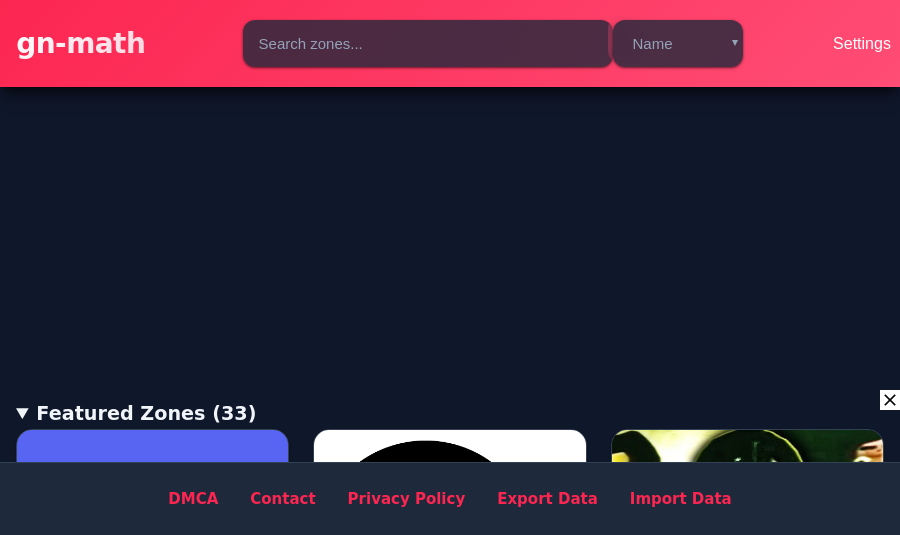
Image source: JSitor
Another alternative is offline play. The GN-Math repository documentation notes the existence of "offline math games for Windows." Because the games are built on HTML5, you can actually download the entire repository to a USB flash drive at home. By opening the index.html file directly from the USB drive on a school computer, the games will run locally in the browser without requiring an internet connection, completely bypassing network web filters.
Finally, to find the most recent working links, users should monitor the GitHub Topic Hubs for "gn-math." Developers frequently push updates and post new mirror URLs in the repository readmes when older domains are taken down.
Frequently Asked Questions
Is GN-Math actually an educational site for learning math?
Is it safe to use GN-Math on a school computer?
Why do some games on the platform load slowly or fail to start?
Can I save my progress in GN-Math games?
about:blank injection method to hide their activity, the browser's local storage (which saves game data) is often cleared when the blank tab is closed. For games requiring long-term progression, playing on a standard mirror without the stealth launch is recommended.
What is the newest official version of GN-Math?
gn-math-t.github.io) are no longer being updated. The primary official hub has transitioned to the gn-math.dev domain space.
How do I report a broken game on the site?
Final Thoughts
Navigating the cat-and-mouse game of school web filters requires an understanding of how modern web hosting and browser mechanics operate. GN-Math remains a top-performing option for unblocked gaming due to its clever use of stealth tactics and decentralized hosting.
- Use the updated domain: The legacy GitHub sites are deprecated; look for
gn-math.devor recently updated community mirrors for the latest 150+ games. - Leverage the Launch button: Utilizing the
about:blankinjection method is highly effective for keeping your gaming activity out of local browser history logs. - Beware of active monitoring: Stealth URLs will not protect you from screen-monitoring software like GoGuardian or Securly used by teachers.
- Self-host for permanence: Deploying your own fork of the repository via Vercel or Netlify is the most reliable way to ensure long-term, unblocked access.
- Utilize the CDN backdoor: If primary domains fail, accessing game files directly through the jsDelivr proxy can often bypass network restrictions.