
What Is the Highest Galaga Score Ever Recorded and How Can You Reach It?
Quick Answer: As of 2026, the highest recorded Galaga score on Marathon settings is 20,980,450 points, achieved by Jordan Dorrington. Under stricter Tournament settings (limited lives, hardest difficulty), the record is 4,525,150 points held by Andrew Laidlaw. Reaching these tiers requires mastering the "Double Ship" strategy, exploiting the Player 2 hardware advantage, and dedicating up to 15 hours of continuous gameplay.
Since its release by Namco in 1981, Galaga has remained a cornerstone of competitive arcade gaming. Unlike modern titles with definitive endings, Galaga is a test of endurance, pattern recognition, and psychological stamina. For decades, players have debated what constitutes a "good" score, how to properly configure the arcade cabinet for official runs, and whether certain hardware quirks are legitimate strategies or banned exploits.
Whether you are playing on an original 1981 upright cabinet, a modern Arcade1Up machine, or a software emulator, understanding the deep mechanics of the game is essential. This guide breaks down the official records, the mathematical point values of every enemy, and the specific strategies required to elevate your gameplay from casual to legendary.
Who Holds the Current Galaga World Record?
When discussing the highest achievements in Galaga, it is crucial to distinguish between the two primary categories of competition: Marathon and Tournament. The ruleset dictates the difficulty, and consequently, the final score ceiling.
Andrew Laidlaw — 4,525,150 points. Achieved under Twin Galaxies Tournament Settings. This ruleset is notoriously punishing: players start with only five lives, earn no extra lives throughout the run, and the game is set to "Rank D" (the hardest difficulty, featuring faster enemy dive speeds and aggressive projectile rates). This record is widely recognized by Guinness World Records as the definitive benchmark for pure skill.
Jordan Dorrington — 20,980,450 points. Achieved in January 2020. Marathon settings allow the game to award extra lives at specific point thresholds (typically every 70,000 points). Because skilled players can earn lives faster than they lose them, the game theoretically continues infinitely until the player succumbs to physical exhaustion or triggers a hardware crash. Dorrington's run is celebrated across the competitive arcade community as a monumental feat of endurance.
The time factor is often the most significant barrier to entry for marathon records. Based on the game's internal pacing and the maximum number of enemies per stage, scoring 1 million points takes approximately 45 to 60 minutes of flawless play. Therefore, a 20-million-point run requires nearly 15 to 20 hours of continuous, unbroken concentration. Players attempting these runs must manage physical fatigue, eye strain, and the psychological pressure of maintaining perfect execution over thousands of stages.

Image source: YouTube
How Does Your Galaga Score Compare to Other Players?
A common question among retro gaming enthusiasts is, "Is my score actually good?" Because the learning curve is steep, casual players often plateau early. Based on aggregated community data and tournament qualification thresholds, player performance generally falls into five distinct skill brackets.
| Skill Tier | Score Range | Player Characteristics & Milestones |
|---|---|---|
| Beginner | 0 – 100,000 | Learning basic enemy flight patterns. Often struggles with the first few Challenging Stages and frequently loses ships to unpredictable red moth dives. |
| Intermediate | 150,000 – 300,000 | Has mastered the "Double Ship" strategy. Can consistently clear early stages without losing lives and achieves perfect bonuses on the first two Challenging Stages. |
| Advanced | 500,000 – 900,000 | Consistently reaches Stage 20 and beyond. Understands how to manipulate enemy fire rates and can navigate the aggressive speed increase that occurs in later levels. |
| Expert | 1,000,000 – 4,000,000 | Tournament-level play. Capable of "flipping" the standard 6-digit scoreboard. Relies on deep memorization of all 40-enemy bonus stage patterns. |
| Legendary | 10,000,000+ | Marathon endurance runners. Gameplay is entirely systematic. Players at this tier are actively managing hardware limitations and preparing for the Stage 255 kill screen. |
Moving from the Intermediate to the Advanced tier usually requires a fundamental shift in visual focus. Instead of looking directly at their own ship, advanced players train themselves to look at the middle of the screen, using peripheral vision to dodge incoming fire while tracking the origin points of diving enemies.
Why Do World Record Players Always Use the Player 2 Side?
If you watch a video of a world record attempt, you will notice a peculiar detail: the player is almost always operating on the "Player 2" side of the screen, even if they are playing alone. This is not a superstition; it is a strict requirement born from the hardware limitations of the original 1981 Namco Z80 arcade board.
When the developers programmed Galaga, they allocated a specific amount of visual memory (sprites) for the on-screen score display. On the Player 1 side, the score is hardcoded to display a maximum of six digits (999,990). If a player scores 1,000,000 points on the Player 1 side, the score visually "rolls over" back to 000,000, even though the internal memory still tracks the correct value.
However, due to a quirk in how the display routines were written, the Player 2 side has access to adjacent memory addresses that allow it to display the 7th and 8th digits. As demonstrated by high-level players like Armando Gonzalez, using the Player 2 side is the only way to generate visual proof of a multi-million point run. Without those extra digits visible on screen, verifying a marathon record becomes nearly impossible for adjudicators.
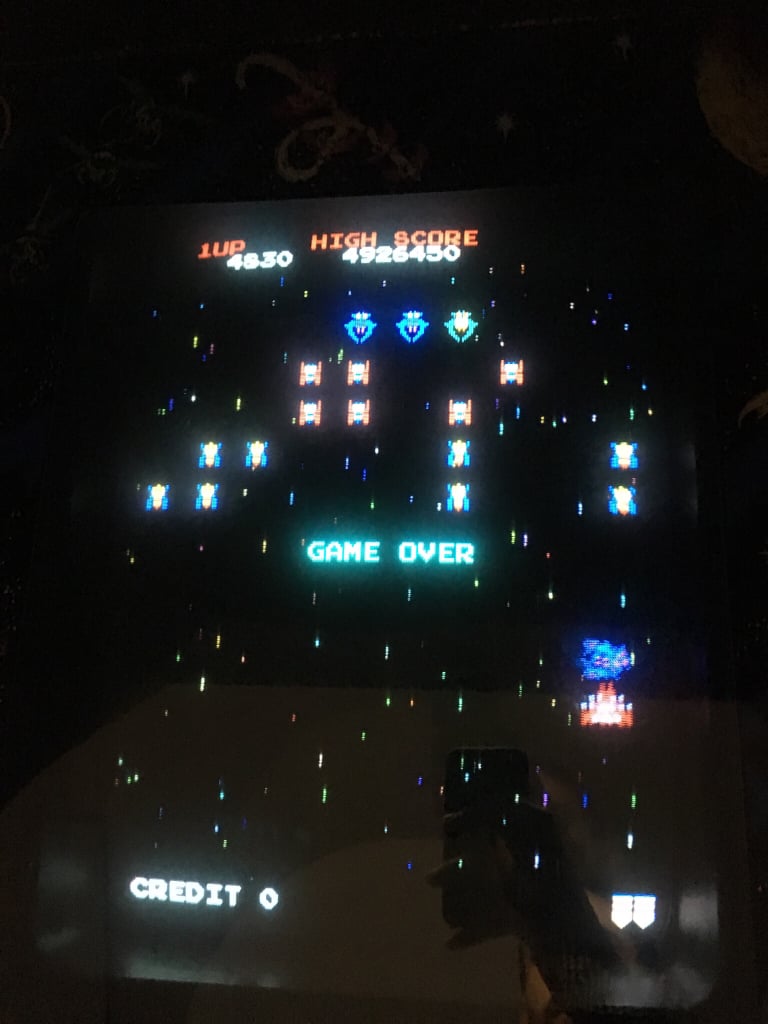
Image source: Museum of the Game® & International Arcade Museum® Forums - International Arcade Museum
How to Use the No-Fire Glitch to Inflate Your Score
One of the most famous exploits in arcade history is the Galaga "No-Fire" glitch. When executed correctly, this trick causes all enemies to permanently stop shooting projectiles for the remainder of the game, drastically reducing the difficulty and turning marathon runs into pure tests of stamina rather than reflex.
According to discussions among arcade historians on the Arcade Museum Forums, there is ongoing debate about whether this was a programming oversight (a buffer overflow in the enemy fire logic) or an intentional debug tool left in the code by developers to test later stages.
Step-by-Step Execution
- Start a new game and progress to Stage 1 or Stage 2.
- Destroy all enemies in the formation except for the two blue moths (bees) located on the far left side of the screen.
- Position your ship in the bottom right corner to minimize danger.
- Wait for approximately 15 minutes. The two remaining moths will continuously dive and fire at you. You must dodge their attacks without destroying them.
- Eventually, the moths will stop firing projectiles entirely, though they will continue to dive.
- Once you confirm they are no longer shooting, destroy them to end the stage. From Stage 3 onward, no enemy will fire a single shot.
The No-Fire glitch does not work on every version of Galaga. It is fully functional on original "Revision B" arcade ROMs and many modern Arcade1Up cabinets. However, Namco actively patched this exploit in later releases. If you are playing on the NES port, the "Namco Museum 50th Anniversary" console collections, or most modern digital storefront versions, the glitch will not trigger, no matter how long you wait.
Master the Point Values for Every Enemy Type
To maximize your score before fatigue sets in, you must understand the exact mathematical value of every action. Galaga rewards aggressive play; enemies are worth significantly more points when they are actively diving compared to when they are idle in the top formation.
According to mechanical breakdowns by PrimeTime Amusements, prioritizing diving targets is the foundation of high-level scoring.
| Enemy Type | Points (In Formation) | Points (Diving) | Special Conditions |
|---|---|---|---|
| Blue Moths (Bees) | 50 | 100 | Standard grunt enemy. |
| Red Moths (Butterflies) | 80 | 160 | Often dive in erratic, sweeping patterns. |
| Boss Galaga (Green/Yellow) | 150 | 400 | Diving solo without escorts. |
| Boss Galaga + 1 Escort | 150 | 800 | Destroying the Boss while it dives with one red moth. |
| Boss Galaga + 2 Escorts | 150 | 1,600 | The highest standard point payout. Requires precise timing. |
The Transformation Bonus
In later stages, you will notice certain enemies pulsing and transforming into different shapes (often resembling scorpions or purple stingrays) as they dive. These transformed enemies are high-value targets, awarding between 1,000 and 3,000 points each depending on the stage. Expert players will intentionally leave specific enemies alive in the formation to trigger these transformations, farming them for massive point boosts.
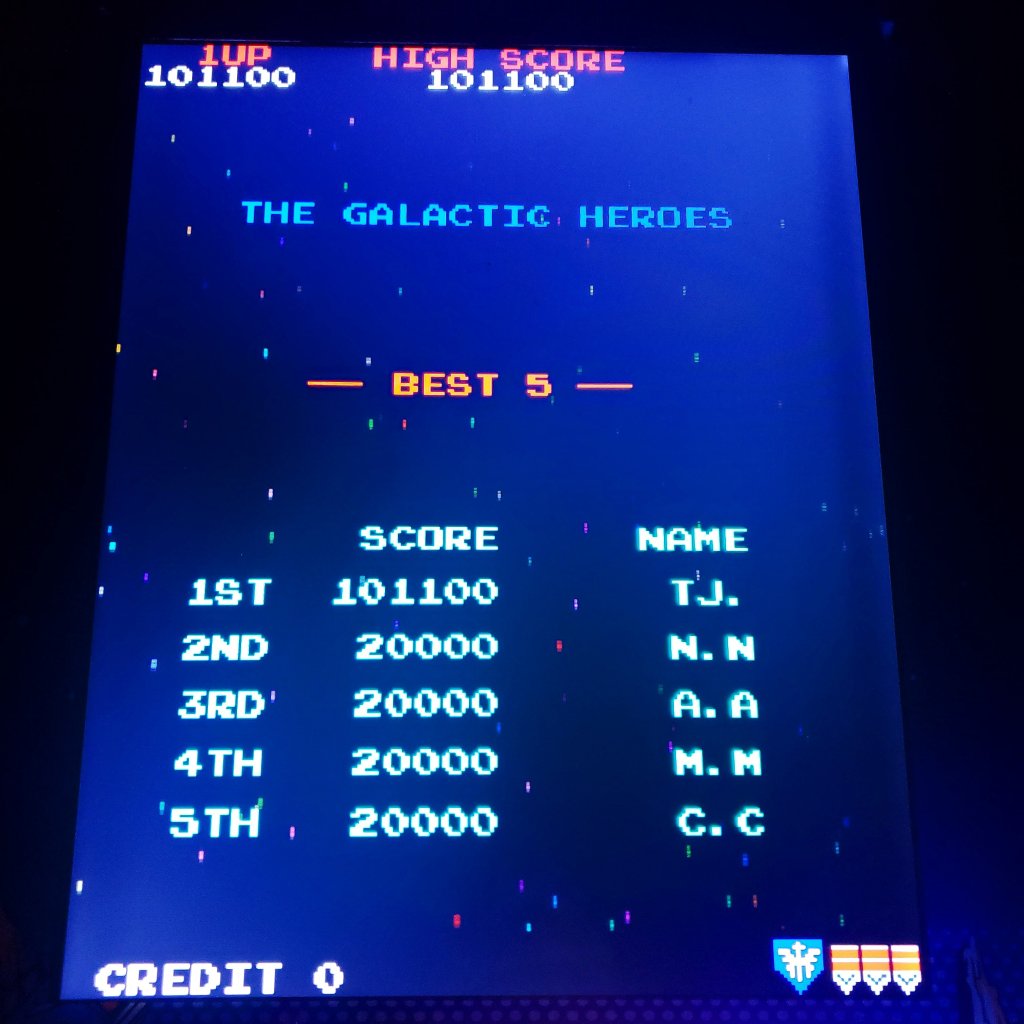
Image source: Retro Game SuperHyper
Essential Strategies for Breaking the 1 Million Point Barrier
Reaching a seven-figure score requires more than just fast reflexes; it requires a systematic approach to resource management and risk mitigation.
The Double Ship (Tractor Beam) Method
The most critical strategy in Galaga is intentionally sacrificing a life to double your firepower. When a Boss Galaga dives and emits its blue tractor beam, allow your ship to be captured. On your next life, shoot the Boss Galaga while it is diving (not while it is in formation) to rescue your captured ship. The two ships will link together side-by-side.
While this doubles the size of your hitbox—making you an easier target—the ability to fire two missiles simultaneously is a highly effective trade-off. It allows you to clear formations twice as fast, reducing the amount of time enemies have to dive at you. It is also practically required to achieve perfect scores in the Challenging Stages.
Challenging Stage Perfection
Every few levels, the game presents a "Challenging Stage" where 40 enemies fly onto the screen in complex patterns without firing. Destroying all 40 enemies awards a 10,000-point "Perfect" bonus. Over the course of a 1-million-point run, these bonuses account for a massive percentage of your total score. Because the flight paths are hardcoded and never change, players must memorize the exact positioning and timing for all 40 enemies across the different stage variations.
The Rapid Fire Debate
Many modern home cabinets and emulators include an "Auto-fire" or "Rapid Fire" button, allowing players to hold down the button rather than manually tapping it. While this reduces physical fatigue, it fundamentally alters the game's difficulty. The original arcade hardware limits the player to two on-screen missiles at a time. Official tournament rankings, such as those maintained by Twin Galaxies, strictly ban the use of auto-fire modifications. If you are practicing for an official record, you must learn to manually feather the fire button.
What Happens at the Galaga Kill Screen?
Like many early arcade games (most notably Pac-Man and Donkey Kong), Galaga was not programmed with an ending. The developers used an 8-bit integer to track the current stage number. In hexadecimal computing, an 8-bit integer has a maximum value of 255 (represented as `FF`).
When a player successfully completes Stage 255, the game attempts to roll the counter over to Stage 256. Because the hardware cannot process this number, the counter resets to `00` (Stage 0). This triggers the infamous Galaga Kill Screen.
Depending on the specific ROM revision, one of two things will happen at Stage 0. The game may completely crash, freezing the screen and forcing a hard reset of the cabinet. Alternatively, the game may load a glitched level where the difficulty pointers become corrupted, resulting in erratic enemy behavior or immediate game-over states. Reaching Stage 255 is considered the ultimate benchmark of a marathon runner's capability.
Common Problems When Chasing a High Score
Players attempting to push their scores higher often run into technical and mechanical roadblocks that have nothing to do with their actual skill level.
Hardware Saving Issues
A frequent complaint among retro collectors is the loss of high scores when the machine is powered off. Original 1981 cabinets did not feature non-volatile RAM (NVRAM) or hard drives; scores were stored in temporary memory and wiped when the power was cut. Similarly, some early generations of Arcade1Up cabinets suffered from software bugs that failed to write high scores to the flash memory. If you are setting a record, always record your screen with a camera, as the machine itself may not preserve your achievement.
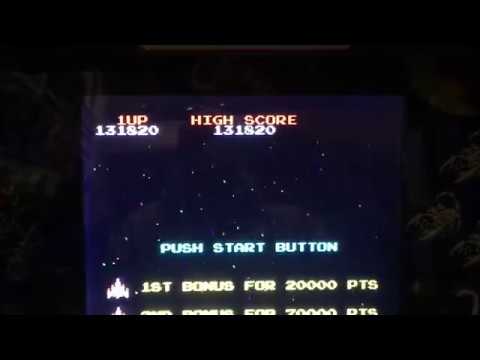
Image source: YouTube
Captured Ship Friendly Fire
When attempting to rescue a captured ship to form the Double Ship, players must shoot the Boss Galaga holding it. However, if you miss the Boss and hit your own captured ship, it will be destroyed, costing you a life and ruining the setup. This is especially common when players panic during a fast dive or when using unauthorized rapid-fire mods that spray bullets uncontrollably.
Screen Size and Peripheral Vision
It may seem counterintuitive, but playing Galaga on a massive 50-inch modern television can actually lower your score. The original arcade cabinet utilized a 19-inch CRT monitor oriented vertically. This compact size allowed players to keep the entire playfield within their central field of vision. On a large modern display, the player's eyes must physically dart back and forth across a much wider area, increasing reaction time and causing fatigue. For optimal performance, smaller screens are widely regarded as superior for vertical shooters.
Frequently Asked Questions
Final Thoughts on Mastering Galaga
Achieving a high score in Galaga requires a blend of deep hardware knowledge, pattern memorization, and sheer physical endurance. Whether you are aiming to beat your personal best or chasing a multi-million point marathon run, success comes down to consistency.
- Understand the Records: The 20.9M Marathon record allows extra lives, while the 4.5M Tournament record demands perfection on the hardest settings.
- Use Player 2: If you plan to score over 1 million points, you must play on the Player 2 side to ensure the 7th and 8th digits render correctly on screen.
- Master the Double Ship: Sacrificing a life early to secure dual firepower is a mandatory strategy for clearing late-game formations.
- Memorize Bonus Stages: The 10,000-point perfect bonuses from Challenging Stages are essential for inflating your score efficiently.
- Target Diving Enemies: Always prioritize enemies while they are diving, as their point values double or even quadruple compared to when they are idle.
- Beware the Glitch: The 15-minute "No-Fire" trick works on original arcade boards but is patched out of most modern console ports.
